
 The Presidential Office on Bankova Street is a bad apartment. Especially after it was inhabited for so long by a sorcerer, a gay man and practitioner of the black arts — Andriy Yermak. It was from there, with the help of love spells, multicolored cords and cemetery soil, that Yermak allegedly managed to control President Zelensky for so long.
Yet Yermak’s departure did little to improve the atmosphere in the apartment.
For example, everyone is now looking for a certain Kyrylo — “the Boss,” Kyrylo Oleksiyovych — who, according to NABU recordings, collects off-the-books money for court bail, hands out salaries in envelopes and takes control of banks. Yet somehow no one can find this mysterious Kyrylo.
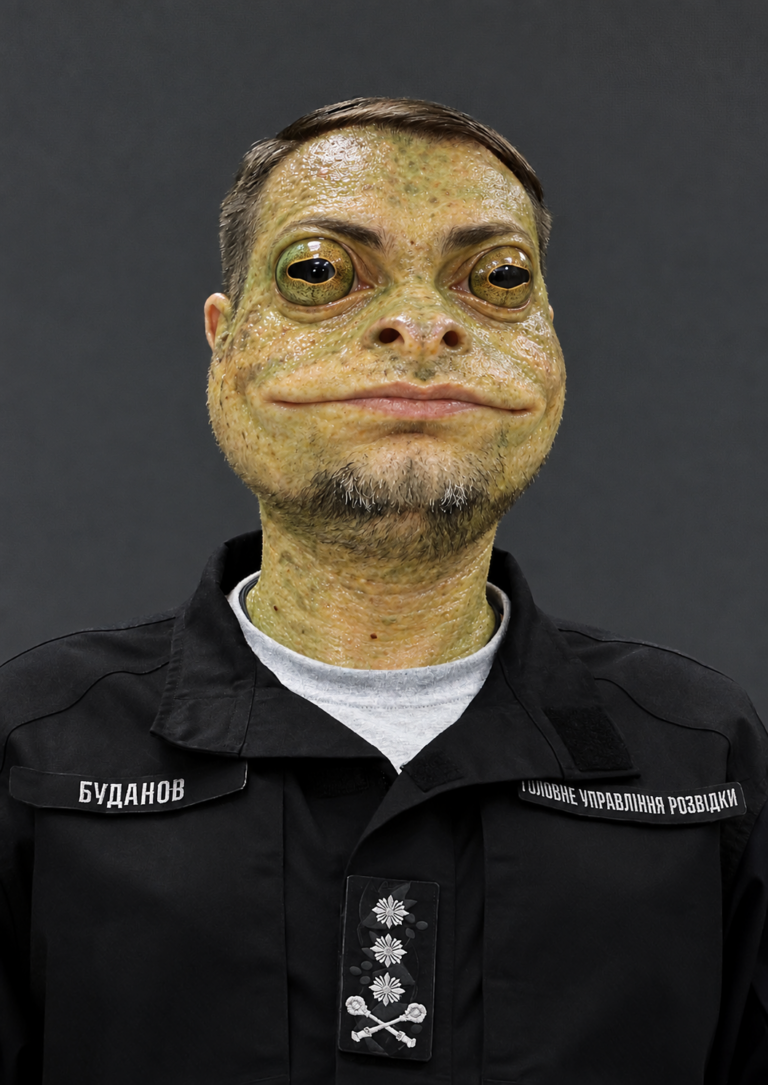
Yermak’s occultist, Valya Chorna, claims that the explanation is simple: Kyrylo Budanov is also a magician — only an aquatic one. More precisely, a shape-shifter, something along the lines of a merman. No wonder there are so many photographs of him wearing flippers.
And apparently he brought his favorite toad, named “Petya,” with him from “the Island” to Bankova. Presumably in honor of Nedzelsky.
In reality, so the story goes, the real Kyrylo Oleksiyovych usually sits in an aquarium eating bloodworms, while Petya the toad, disguised as Budanov, hands out money, makes money and, whenever anyone asks a question, simply opens his mouth very wide.
Such is the mysticism of the bad apartment.
Where did Budanov come from in the first place?
Kyrylo Budanov was born in Kyiv on January 4, 1986.
He grew up on Kyiv’s Left Bank, in the Darnytsia district. According to Babel, his father, Oleksiy Budanov, worked during the Soviet period as an engineer at the Kyiv Radio Plant, an enterprise involved, among other things, in manufacturing components for the space industry. After the collapse of the Soviet Union, he went into a business related to battery recycling.
His mother, Tetiana Budanova, worked at a civil registry office and later became a homemaker.
Budanov attended Kyiv School No. 128.
One curious detail is that the school was located quite far from his home. In the 1990s, with support from the Jewish community, it had special classes that received additional funding and offered Hebrew instruction. Budanov himself has said that he still remembers some of the language.
As a child, Budanov often spent his holidays with relatives in Crimea. There he practiced underwater navigation and received athletic training that, as later profiles noted, proved useful during operations on the peninsula.
In the summer of 2003, immediately after finishing school, the 17-year-old Budanov entered the Odesa Military Institute.
He studied at the Air Assault Forces Faculty, meaning that he was initially trained as an airborne officer.
One of Budanov’s classmates was Oleksandr Fatsevych, who would later become one of the senior figures in Ukraine’s National Police.
A year before graduation, Budanov decided that instead of serving in a regular air-assault unit he wanted to join military intelligence.
According to Fatsevych’s recollections, such a transfer was unusual: officers trained by the airborne faculty were normally retained for service in airborne units. After graduation, acquaintances were surprised to learn that Budanov had ended up in the Defence Intelligence of Ukraine, the HUR.
There were rumors that his mother had played some role in making this possible.
Budanov specialized as an underwater saboteur.
Before 2014, he did not take part in any combat operations.
A very curious episode from his early career has only recently entered the public domain.
According to Babel, at the beginning of the war Budanov had a conflict with Maksym Shapoval, who commanded a HUR special operations unit. The reason for the conflict remains unknown.
Shapoval allegedly temporarily reassigned Budanov to serve in Kyiv Oblast, effectively removing him from the first groups being sent into the combat zone.
However, one of the commanders insisted that Budanov be included in the next group and personally took responsibility for him.
Later, Budanov and Shapoval apparently repaired their relationship.
Shapoval subsequently became one of the most important figures in Ukraine’s military special operations community and was killed in Kyiv when his car exploded in June 2017.
By 2016, Budanov had reached the rank of major.
He was still virtually unknown.
That changed when he came to the attention of Valerii Kondratiuk.
Budanov became publicly known after Kondratiuk’s notorious “Crimean raid.”
Kondratiuk became head of the HUR in March 2015. But, apparently, the position was not enough for him and he decided that he needed to do something spectacular.
For example, send a group of saboteurs into Crimea and blow something up.
However, given that Kondratiuk had never had any meaningful operational experience, the operation ended in failure.
He appointed the young and hot-headed Major Budanov to command the group.
This is how Volodymyr Boiko describes the episode:
“But the biggest scandal was caused by the story of the so-called ‘Crimean saboteurs,’ when on August 6, 2016, a five-man sabotage group from the Main Intelligence Directorate of the Ukrainian Ministry of Defence infiltrated occupied Crimea.
Near the village of Suvorove, the saboteurs were supposed to be met by car by Andrii Zakhtei, an agent recruited by Ukrainian military intelligence. But in reality, an ambush was waiting for them there — Russian special forces from the Vympel unit.
The Ukrainian saboteurs managed to break out of the ambush, killing several Russians, including Lieutenant Colonel Roman Kamenev, and during the night of August 7–8, 2016, they crossed the causeway over the Syvash and returned to mainland Ukraine, killing one more member of the occupying forces on the way.
In the end, Russian authorities detained only two HUR agents — Andrii Zakhtei and Yevhen Panov — while the sabotage group itself returned home.
The madness of this sabotage raid was obvious: Ukraine had long since treated Crimea as Russian territory in practice and throughout 2015 continued supplying electricity to the ‘Crimean Federal District,’ having signed the relevant agreement, thereby helping sustain the occupation forces.”
Boiko continues:
“So what was the point of sending a HUR sabotage group into Crimea and risking the lives of military intelligence officers and agents recruited on the peninsula if an electricity blockade could have caused the occupying forces incomparably greater damage?
And if Ukraine had, in practice, accepted Crimea as Russian territory, was helping the Russian Federation supply electricity to its military units and assisting the construction of a bridge across the Kerch Strait, then what was the point of simultaneously organizing sabotage?
Especially given that their Russian counterparts appeared to learn in advance about Kondratiuk and Burba’s special operations.”
According to Boiko, on August 19, 2016, after learning about the adventures of the “Crimean saboteurs,” a surprised U.S. Vice President Joe Biden telephoned Petro Poroshenko and complained about Kondratiuk.
Boiko quotes the conversation as follows:
Joe Biden: “…My team briefed me in detail on the events that took place over the weekend of the 7th and 8th. Klimkin had previously shared details of those events concerning operations by Ukrainian security officers with the Ambassador. But ultimately, you are the President of Ukraine and full responsibility falls on you…
“Your military intelligence chief received a clear signal from us several weeks ago regarding our categorical rejection of the planned sabotage operation against military facilities on Russian territory.
“And I know that Crimea is Ukraine and that it is illegally occupied. At the same time, we are firmly convinced that increasing the cost of the occupation for Russia should be achieved exclusively through political and diplomatic means, not through military and sabotage operations…
“But incidents like these… we need to establish exactly what happened. And ensure that the Russians cannot exploit it.
“We know what happened. Four divers were detained, all four disappeared, then there was another firefight the following night, and you may have had nothing to do with it, but Putin decided to blow the scandal up.
“And I understand when you send your Foreign Minister to Berlin and Paris… but if they find out about this before you have informed them, that is a catastrophe.”
Poroshenko is quoted as responding:
Petro Poroshenko: “Thank you, Joe, for a very frank conversation. Once again, I would like to repeat: this happened while I was visiting Southeast Asia.
“We have taken important measures to ensure that a similar situation cannot arise again in the future.
“The only reason we are not dismissing the head of the HUR is that I do not like the idea of doing it right now, because anyone could interpret that as an admission of responsibility…
“I will conduct a very thorough internal investigation and the results will be available soon.”
And indeed, a month after this conversation Kondratiuk left his position as head of the HUR.
According to Boiko, however, this happened not because of the internal investigation Poroshenko had promised Biden, but because a vacancy opened up for the position of deputy head of the Presidential Administration, previously occupied by Kondratiuk’s close friend Andrii Taranov.
On Sunday, September 18, 2016, Kondratiuk and Taranov were drinking at “the Island.”
Boiko alleges that Kondratiuk became so intoxicated that he lost consciousness, while Taranov, who could still stand, decided to take a jet ski out onto the Dnipro.
Near Havanskyi Bridge, the jet ski collided with a barge and Taranov was killed.
According to Boiko, Kondratiuk only learned about the accident the following day because his subordinates had been unable to wake him.
Kondratiuk then moved to the Presidential Administration, installed his loyal associate Vasyl Burba at the head of the HUR and spent the next two and a half years loyally serving Poroshenko.
A week before the second round of the 2019 presidential election, on April 14, when it had already become obvious that Poroshenko was headed for defeat against Zelensky, Kondratiuk attempted to switch to the winning camp.
According to Boiko, he began attacking his former patron and even publicly announced his resignation “at his own request” from Poroshenko’s Presidential Administration.
But that did not save him.
After the inauguration of the new president, Kondratiuk was pushed out — unlike his protégé Burba, who continued to head the Main Intelligence Directorate of the Ministry of Defence.
The only position Kondratiuk could theoretically hope to obtain was head of the Foreign Intelligence Service, because nobody from the Kvartal 95 team was competing for it.
But Burba had his eye on the same job. He understood that the new authorities were unlikely to tolerate him at the head of the HUR indefinitely either.
This finally destroyed the relationship between the former friends, and for roughly a year Kondratiuk reportedly dreamed only of taking revenge on the “ungrateful” Burba.
As long as the state apparatus on Bankova was run by Andriy Bohdan, an experienced practitioner of palace intrigue, neither Kondratiuk nor the gossip he spread about Burba attracted much attention.
The situation changed when Andriy Yermak came to power.
Kondratiuk immediately offered his services to the new presidential leadership, allegedly promising to provide “devastating kompromat” against Poroshenko in exchange for appointment as head of the Foreign Intelligence Service.
The supposedly “devastating kompromat” turned out to be Poroshenko’s Decree No. 225/2018 of July 31, 2018 appointing the notorious Serhii Semochko as First Deputy Head of the Foreign Intelligence Service.
Kondratiuk, who had prepared the decree, recalled that before Semochko’s appointment the Foreign Intelligence Service staffing structure contained only one position of First Deputy Head, which was occupied by Andrii Alekseienko.
Therefore, the argument went, Poroshenko’s appointment of another First Deputy Head of the Foreign Intelligence Service constituted a crime so grave that it would supposedly shake the civilized world.
The idea was warmly received by the Presidential Office.
On June 5, 2020, by Zelensky’s Decree No. 212/2020, Valerii Kondratiuk was appointed head of the Foreign Intelligence Service.
And on June 10, 2020, amid what Boiko describes as Homeric laughter throughout Ukraine’s legal community, Poroshenko was formally notified that he was suspected of illegally appointing Semochko as First Deputy Head of the Foreign Intelligence Service.
The fact that Kondratiuk had close ties to U.S. intelligence agencies and to senior figures in the U.S. Democratic Party did not prevent his appointment as head of the Foreign Intelligence Service.
At least, the dossier on Kondratiuk that was allegedly circulating through the offices of the Presidential Office appears to have made little impression on Andriy Yermak.
The document allegedly stated:
“V. Kondratiuk and his wife have spent their entire careers exclusively in public service positions. At the same time, according to preliminary estimates, V. Kondratiuk’s assets exceed USD 2 million.
According to state registers, he owns a private house with a total area of 484 square meters in the Konyk cottage community, with an estimated value of USD 1.5 million; and a garage at 10a Staronavodnytska Street.
It is also known that V. Kondratiuk transferred several real-estate properties into his son’s name, including an apartment at 46/2 Moskovska Street, Apartment 174, Kyiv, with an estimated value of USD 300,000, two garages in Kyiv and two land plots in the Kyiv suburbs with a combined estimated value of approximately USD 100,000.
According to available information, while serving as head of the HUR of the Ministry of Defence of Ukraine, V. Kondratiuk repeatedly received improper benefits in connection with contracts under the State Defence Order.
In particular, in 2016, the management of NPF Krypton LLC, a contractor under the State Defence Order, allegedly purchased and transferred to V. Kondratiuk a new armored Toyota Land Cruiser 200, registration AA0634SR, worth approximately USD 200,000.
Also in 2016, his wife, T. M. Kondratiuk, received as a gift a Lexus GS 460, registration AA7888KE, and purchased an apartment at 38/14 Budivelnykiv Street, Apartment 41, Kyiv.
It is known that V. Kondratiuk owns a Toyota Sienna, registration AA8878IO.
Particular attention should be paid to the alleged receipt by V. Kondratiuk of an improper benefit under Article 368 of the Criminal Code of Ukraine in the form of an apartment at 3-H Maksymovycha Street, Apartment 197, Kyiv.
The apartment was allegedly ‘gifted’ — that is, provided as a bribe — by a developer to a close relative, his mother-in-law, after the developer signed a construction contract with the HUR, represented by V. Kondratiuk, concerning the site at that address.
It should be noted that the developer transferred apartments to the HUR without interior finishing, although the paperwork allegedly stated that the apartments had been delivered fully renovated.
It is also alleged that, while serving as head of the HUR, Kondratiuk issued a ‘Top Secret’ order appointing his wife, T. M. Kondratiuk, to an officer position within the HUR and granting her an officer rank, despite an apparent conflict with Ukraine’s anti-corruption legislation and a direct conflict of interest.
According to the allegation, T. M. Kondratiuk has not once appeared at work since 2015.
Kondratiuk’s eldest son, Vladyslav Valeriiovych Kondratiuk, studied at a university in Washington, United States, where he lived and studied for three years, coinciding with V. Kondratiuk’s tenure as head of the HUR. It is alleged that 75 percent of the expenses were paid by the CIA.
His middle son, Oleksandr Valeriiovych Kondratiuk, attends a private school and lives in New York, United States.
Kondratiuk’s third son was born in Miami, United States, in the summer of 2019, automatically making him a U.S. citizen.”
What is more, people claim that Kondratiuk’s connections with U.S. intelligence and his personal acquaintance with Joe Biden ultimately became decisive factors in his appointment as head of the Foreign Intelligence Service.
When Biden visited Ukraine as Vice President, the story goes, he would allegedly ask that Kondratiuk personally drive him to Boryspil Airport on the way home.
According to this version, Kondratiuk promised Yermak that if Biden won the U.S. presidential election he would establish direct cooperation with the new American administration.
In exchange, Kondratiuk immediately asked for his former friend and associate Burba to be removed as head of the HUR.
He allegedly told Yermak that Burba had recorded and passed to MP Andrii Derkach the 2016 telephone conversations between President Poroshenko and U.S. Vice President Joe Biden.
According to Boiko, Kondratiuk knew perfectly well that Derkach had actually published recordings officially made by the Presidential Administration during Poroshenko’s conversations with Biden and stored on the Situation Room servers.
But the final argument that allegedly sealed Burba’s fate was Kondratiuk’s claim that Burba might have been involved in surveillance of Yermak’s brother between August and October 2019.
That surveillance produced covert recordings in which Yermak’s younger brother appeared to be discussing appointments to government positions on his brother’s behalf.
According to Kondratiuk’s account, Yermak’s brother was allegedly monitored on the instructions of then-head of the Presidential Office Andriy Bohdan by officers of the 5th Directorate of the SBU Counterintelligence Department under Roman Chervinskyi.
When, following internal intrigues, Chervinskyi left the SBU in April 2020, Burba brought him into the HUR.
In Kondratiuk’s version, this supposedly demonstrated Burba’s connection to the production and dissemination of the scandalous recordings.
After that, Burba’s fate was allegedly decided instantly.
There was supposedly no doubt about whom Kondratiuk wanted to install in his place at the head of the HUR.
He chose Kyrylo Budanov — one of the very same “Crimean saboteurs” whose operation had caused such anger on Biden’s part.
According to Boiko, the new head of the HUR was chosen according to the same principle supposedly used by the boyars when they selected the 16-year-old Mikhail Romanov as Tsar of Russia in 1613:
“Misha is young and hasn’t grown into his brains yet.”
Boiko argues that the principal virtues of the new military intelligence chief were his complete loyalty to Kondratiuk, his unwillingness to interfere with alleged corruption schemes inside the HUR and his readiness to listen to American handlers.
And most importantly, he claims, Kondratiuk would once again be able to arrange an officer’s position in the HUR for his wife.
Wagnergate
“Wagnergate” ended for Budanov not only with allegations that an attempt had been made to plant a syringe containing heroin on Burba, but with another extraordinary episode.
According to the account cited in the original text, Budanov personally tried to persuade a British intelligence officer to prevent the publication of an investigation into Wagnergate.
Naturally, this effort itself allegedly exposed him.
There is, after all, a difference between being a combat swimmer and being an intelligence case officer.
Shapoval had apparently hinted at this to Budanov, but Kondratiuk convinced him that operational tradecraft was not the preserve of gods.
Yet less than six months later, Kondratiuk and Budanov became embroiled in another international scandal.
We quote Naspravdi:
“Scientists still do not know where to look for the Higgs boson, whether there is life on Mars, or why a group of military intelligence officers from the Main Intelligence Directorate of the Ukrainian Ministry of Defence kidnapped former Kyiv Dniprovskyi District Court judge Mykola Chaus in broad daylight in central Chișinău on April 3, 2021.
“First, let us reconstruct the movement of Mykola Chaus’s body through time and space.
Journalists from the Moldovan project RISE Moldova reconstructed, almost minute by minute, the movement of the judge across Moldovan territory.
“The abduction took place on April 3, 2021, at 12:10 p.m., near the building at 24/5 Nicolae Testemițanu Street in Chișinău, in the courtyard of student dormitories near the sports complex of the University of Medicine and Pharmacy.
“The abductors forced Chaus into a white Ford Transit van.
“The van then left the scene and, fifteen minutes later, was beneath the bridge connecting the Botanica district with central Chișinău.
“There, Chaus was transferred into a black Mercedes-Benz passenger car and driven onward.
“At approximately 1:03 p.m., on Doina Street near the old Saint Lazarus Cemetery on the outskirts of the city, Chaus was transferred again.
“This time he was placed in a black Toyota RAV4 bearing registration plates CD120MA.
“The vehicle belonged to the Embassy of Ukraine in the Republic of Moldova.
“From there, the Toyota RAV4 with diplomatic plates and Judge Mykola Chaus inside, driven by Ukraine’s military attaché Colonel Serhii Smetaniuk, traveled roughly 200 kilometers and arrived at 3:32 p.m. at the Otaci–Mohyliv-Podilskyi Moldovan-Ukrainian border crossing.
“Ten minutes later, Mykola Chaus crossed the border and returned to his homeland…”
The author continues:
“It should be noted that virtually all identifying data concerning the Ukrainian military intelligence group — including the name of the special operation commander, Andrii Viktorovych Kutsenko, born September 24, 1984, deputy commander of the HUR special reserve for operational work, copies of all their passports and front- and side-profile photographs — were published on the Internet within days of Chaus’s abduction.
“A few words should also be said about why the identities of all Ukrainian intelligence officers working under unofficial cover and involved in the Chișinău operation were exposed almost instantly.
“First, neither the Main Intelligence Directorate of the Ministry of Defence nor the Foreign Intelligence Service had, according to the author, meaningful practical experience operating illegal foreign residencies under real field conditions.
“There were plenty of staff colonels who spent their foreign assignments shopping and writing fictional reports while receiving substantial salaries, allowances and travel expenses.”
The author asks:
“Who was appointed head of the HUR? What expertise does he possess in the field of military intelligence? What are his greatest achievements?
“For Kyrylo Budanov, the peak of his career had been a reconnaissance and sabotage group raid behind enemy lines into Crimea in 2016.
“His principal achievement was that he remained alive and returned home.
“In other words, for the younger generation of HUR managers, clandestine intelligence apparently resembles playing at reconnaissance and sabotage groups: being able to shoot expertly with every kind of small arm, practice martial arts, plant a mine, eliminate a sentry…
“That is the level of tactical military reconnaissance.
“It is precisely what is prohibited for strategic-level intelligence officers operating under deep cover.”
The author then adds sarcastically:
“Across both intelligence services — the HUR and the SZRU — there is only one specialist who still remembers the difference between an intelligence officer and a saboteur.
“And that is ‘Hamster’!
“How many foreign agents did he recruit in his entire life?
“Nalivaichenko, perhaps, if the legends are to be believed — and even then, supposedly for the Americans…”
The text continues:
“Take a simple question: transport.
“The members of the Chișinău covert group used exclusively rented cars equipped with alarm systems and GPS trackers in case of theft.
“Consequently, the complete routes of every intelligence vehicle could be remotely reconstructed using GPS tracking.
“These are obvious, elementary facts.
“Otherwise, no one would rent you the vehicle in the first place.
“Using such cars demonstrates the absence of the most basic operational skills required for clandestine work abroad.
“Next: did anyone examine the officers’ personal belongings and clothing?
“Why were most of them wearing heavy, military-style boots?
“This was not a reconnaissance and sabotage mission behind a frontline. Why dress like that?
“Nothing in their belongings, clothing or footwear should have distinguished them from ordinary residents of the Moldovan capital.
“I am almost afraid to ask: did they at least leave their weapons at home?
“They did not bring explosives with them, did they?”
The author continues:
“I am not even talking about such a classic technique as an operational combination — solving the task quietly, peacefully and often with the voluntary cooperation of the target, without noise or unnecessary movement.
“But to do that, an intelligence officer must use his principal weapon — his brain.
“Unfortunately, the HUR does not appear to have equipped itself with that weapon yet…”
The article then turns to Moldova:
“We laugh a great deal about Moldovans, but within 48 hours, using the resources of a single police force and personally the mayor of Bălți, Renato Usatîi — and possibly with assistance from ‘professors’ in Moscow — they reconstructed almost minute by minute the entire trajectory of the kidnapped judge from the place of abduction all the way to the Ukrainian-Moldovan border.
“I would not be particularly surprised if I someday learned that the Ukrainian intelligence officers had been under surveillance by several competing intelligence services from the very beginning, and that details of the operation had been leaked, in the finest Ukrainian tradition, even before it began…”
A particularly notable detail, according to the author, was that shortly before the operation Kyrylo Budanov himself had visited Chișinău.
At the final stage of preparations, “Biden’s personal driver,” Valerii Kondratiuk, allegedly arrived there as well.
But the real adventures of the former judge were only beginning.
What happened next?
According to Volodymyr Ariev, an MP from the European Solidarity faction, after being removed from Moldova, former judge Chaus was held at a Ministry of Defence facility in the village of Khotianivka in Kyiv Oblast’s Vyshhorod district, directly opposite the Mezhyhirya residence.
If one drives along the dam beside the Kyiv Reservoir, the entrance to the facility is, according to this account, marked with the appropriate sign.
On the very next day after the kidnapping, a genuine Funkspiel began around the abducted judge.
A reminder: Funkspiel, literally “radio play” or “radio game” in German, is the classic intelligence contest based on the principle of “believe it or don’t believe it.”
In earlier times, Funkspiel operations were conducted through turned agents, telegraph keys and vacuum-tube shortwave radios.
Today, anonymous Telegram channels and paid journalists at scandal-driven internet publications can serve the same purpose, with stories attributed to “reliable anonymous sources.”
The rules of Funkspiel are simple.
A significant piece of information is tossed into the communications network like a dead cat — and it may be genuine information or disinformation.
Participants can take part knowingly or unknowingly, when someone retransmits false information from “trusted sources” without doubting its authenticity.
Winning that intellectual duel is one of the highest expressions of intelligence tradecraft.
Let us therefore follow the course of this fascinating game using the case of the “living dead” Chaus.
On April 4, 2021, at 10:31 a.m., the obscure Telegram channel Moldavskiy Perets published the first sensational photograph of the kidnapped Chaus.
He was wearing a thin black cap pulled low over much of his face, a black hooded jacket, and his right hand was bandaged.
The caption under the photograph read:
“Our subscribers sent us information that the scandalous Ukrainian judge Chaus is alive and well and is currently in Romania.”
This, according to the article, was strategic disinformation about Chaus supposedly fleeing to Romania — the opening shot in a radio game designed to confuse the picture and send investigators in the wrong direction.
At the same time, however, it was also strategic information — effectively a photographic mission report:
“The package has been delivered to its destination, with minor issues.”
Everything would have been fine, except almost nobody read Moldavskiy Perets: it had only 1,797 regular subscribers.
So the information had to be amplified.
The text then recalls an earlier chapter of the Chaus story.
On August 22, 2016, two citizens of the Republic of Moldova — Dorin Damir and Veaceslav Turcu — arrived at Kyiv airport aboard a chartered Mustang 510 business jet, registration YR-TRQ.
The latter closely resembled Judge Chaus.
After that, according to the account, Chaus was provided with a passport issued in the name of Moldovan citizen Veaceslav Turcu and was assisted in crossing the Ukrainian state border without passing through normal border control.
The real Turcu remained in Kyiv.
Finally, on March 1, 2017, fugitive judge Chaus was detained in Moldova.
Obviously, after Poroshenko — “the Grey-Haired Hetman,” as the author calls him — lost power, Oleksandr Hranovskyi had neither the motive nor the capacity to arrange Chaus’s return in the opposite direction.
The final person who allegedly tried to sustain the cover story was former journalist Serhii Leshchenko, whom the original author describes with a series of mocking references.
On April 5, speaking on Channel 24, Leshchenko declared categorically:
“Only Poroshenko could have organized such a special operation!”
But even this assertion could no longer withstand the informational counterattack: numerous photographs and videos of Ukrainian military intelligence officers, taken from every possible angle, together with photographs of passport copies, had flooded the Internet.
Thus ended the first round of the radio game surrounding the kidnapping of Judge Chaus.
In the author’s phrasing, the “eagles of Hamster” — or perhaps more accurately, “Kondratiuk’s hamsters” — suffered a crushing defeat at the hands of the mayor of the provincial city of Bălți, who reconstructed the entire secret HUR operation in roughly two days and published the evidence online for everyone to see.